
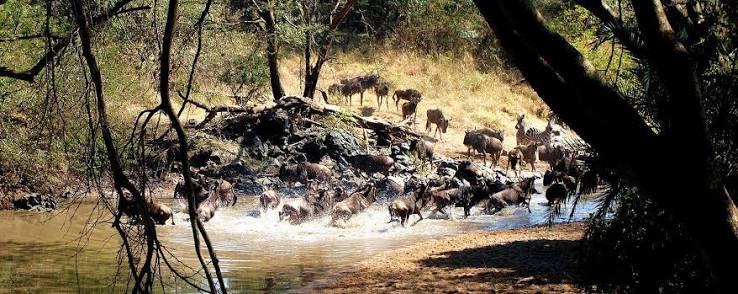
The Western Corridor is where the Great Migration meets its first river of blood and crocodiles — with barely a safari vehicle in sight. A wildebeest migration safari in the Serengeti’s Western Corridor puts you at the Grumeti River between mid-May and July, when up to 1.5 million wildebeest funnel through a narrow 50-kilometre wedge of savannah on their way north. You get the same life-and-death river drama the Mara River is famous for, at a fraction of the crowds and cost.
This guide covers everything you need to plan it: exactly when to go, what the Grumeti crossings look like, how the Western Corridor compares to the Mara River, what a 6-day itinerary costs, and answers to the questions travellers ask us most. When you’re ready, our Wildebeest Migration Safari — Western Corridor runs throughout the crossing season with a maximum of six guests per vehicle.
Wildebeest Migration Safari — Western Corridor: Key Facts
| Best months | Mid-May to July (June is peak); September–October for residual herds |
| Main spectacle | Grumeti River crossings — mega-herds vs. giant Nile crocodiles |
| Herd size | Up to 1.5 million wildebeest plus roughly 250,000 zebra and gazelle |
| Crowds | A handful of vehicles per crossing (the Mara River often draws 30–80) |
| Tour length | 6 days / 5 nights from Arusha |
| Price | $2,000 – $3,200 per person, full board |
| Group size | Maximum 6 travellers |
What Is the Serengeti’s Western Corridor?
The Western Corridor is a narrow arm of Serengeti National Park stretching roughly 50 kilometres west toward Lake Victoria, following the course of the Grumeti River. It is a different Serengeti from the endless short-grass plains of the south: here you find riverine forest, acacia woodland, rolling hills, and dense savannah grassland pressed between two rivers.
Because it sits away from the main Seronera tourism circuit, the corridor stays quiet for most of the year — and then, for a few extraordinary weeks between May and July, it hosts one of the greatest concentrations of large mammals on Earth. The migrating herds pour in from the central Serengeti, stack up against the Grumeti’s channels, and build to astonishing densities before nerve finally breaks and the crossings begin.
When Is the Best Time to See the Grumeti River Crossings?
The short answer: June. The mega-columns — lines of wildebeest stretching to the horizon — typically enter the Western Corridor in late May, and crossing activity peaks through June before the herds push north toward the Grumeti Reserve and Ikorongo in July.
| Month | What’s happening in the Western Corridor |
| Early–mid May | First columns arrive from the central plains in dry years; herds widely spread |
| Late May | Mega-herds mass south of the Grumeti; rutting season fills the corridor with noise |
| June | Peak crossing window — the densest herds and the most river action |
| July | Later crossings as the tail of the migration moves through; herds head north |
| Aug–Oct | Resident game plus straggler herds of wildebeest and zebra; superb, quiet game viewing |
One honest caveat every reputable operator will give you: the migration follows rain, not brochures. A wet year can hold the herds south into July; a dry year can pull them through in mid-May. That is precisely why our itinerary spends three full days in the corridor and positions you along the river with a guide who tracks herd movements daily — time and mobility are what turn “maybe” into a front-row seat.
What Happens at a Grumeti Crossing? -Wildebeest Migration Safari — Western Corridor
The Grumeti River is not wide, but it is deadly. Its permanent pools hide some of Africa’s largest Nile crocodiles — ancient animals five metres and longer that wait all year for these few weeks of plenty. The wildebeest know it. Herds gather at the banks for hours, packed shoulder to shoulder, snorting and testing the water’s edge, until pressure from tens of thousands of animals behind them forces the first leap.
What follows is raw and unforgettable: a churning column of animals surging through crocodile water while lions and hyenas patrol the far bank. Unlike the single dramatic pinch-points of the Mara River, Grumeti crossings are scattered and unpredictable along the river’s length — smaller, more intimate, and often witnessed by just you and a handful of other vehicles. Many guests find that intimacy makes it more powerful, not less.
Grumeti vs. Mara River Crossings: Which Should You Choose?
| Western Corridor (Grumeti) | Northern Serengeti / Mara River | |
| Season | Mid-May – July | July – October |
| Crowds at crossings | A few vehicles | Commonly 30–80 vehicles |
| Style of crossing | Scattered, intimate, unpredictable | Massive single-point spectacles |
| Crocodiles | Among Africa’s largest Nile crocodiles | Abundant large crocodiles |
| Typical cost | Lower — fewer premium camps, shorter transfers from Arusha | Higher — remote camps at premium rates |
| Extras | Rutting season, riverine forest species, balloon safaris (Jun–Aug) | Possible Kenya combination |
If you want the classic photograph with ten thousand animals mid-river, the Maasai Mara delivers it — alongside every other vehicle in the northern Serengeti. If you want to feel the migration — hear the grunting front move through camp at night, watch a crossing with the engine off and nobody else in frame — the Western Corridor is the connoisseur’s choice. Serious wildlife photographers consistently prefer it for exactly that reason; see our photo safaris if clean sightlines matter to you.
Beyond the Crossings: Wildlife of the Western Corridor
The corridor is outstanding even when the river is quiet. Its riverine forests and grasslands hold a strong resident population year-round:
- Big cats — resident lion prides follow the herds; leopards hunt the Grumeti’s forest fringe
- Giant Nile crocodiles and hippo pools — visible at the river in every season
- Elephant, buffalo, topi, eland and giraffe — throughout the woodland and grassland mosaic
- Black-and-white colobus monkeys — a riverine-forest special most Serengeti visitors never see
- African wild dog — rare, but the corridor’s remoter reaches offer genuine chances
- The rut — in late May and June, half a million males bellow, clash and chase across the corridor in Africa’s loudest breeding season
Our 6-Day Western Corridor Migration Itinerary
The Wildebeest Migration Safari — Western Corridor is built to maximise river time while still delivering the classic Serengeti:
- Day 1: Arusha → Central Serengeti. Cross the highlands and enter the park for an afternoon game drive in the Seronera Valley, the Serengeti’s big-cat capital.
- Day 2: Central Serengeti → Western Corridor. Track the herds westward to the Grumeti’s gathering grounds.
- Day 3: Grumeti crossings. A full day positioned along the river — croc-filled pools, massing herds, and the wait for a crossing.
- Day 4: Deeper into the corridor. Grasslands and riverine forest: leopard country, colobus monkeys, and wild dog territory.
- Day 5: Return east. Game drive back across the plains through the migration’s rear-guard.
- Day 6: Serengeti → Arusha. Final morning drive, then return via the Ngorongoro highlands.
The safari runs in a 4×4 Land Cruiser with a professional driver-guide, full-board accommodation, park fees and airport transfers included — $2,000–$3,200 per person depending on season and lodging level, with a maximum of six guests. International flights, visas, insurance, tips and the (highly recommended) sunrise balloon safari are excluded. Want a different length, private departure, or a Mara-River extension into July? Our custom safari packages team builds it around your dates.
Practical Tips for a Western Corridor Safari
- Book 6–12 months ahead for June. The corridor has far fewer beds than the central Serengeti, and crossing-season demand fills them first.
- Stay at least three nights in the corridor. Crossings can’t be scheduled; time on the river is the only reliable strategy.
- Pack for two climates. June mornings are cold on open drives (fleece, beanie); middays are hot and dry.
- Bring reach. A 200–400mm lens covers crossings; a wide angle captures herds to the horizon. Binoculars are non-negotiable.
- Add the balloon. June to August, hot-air balloons fly the Western Corridor at dawn — the only way to grasp the migration’s true scale.