
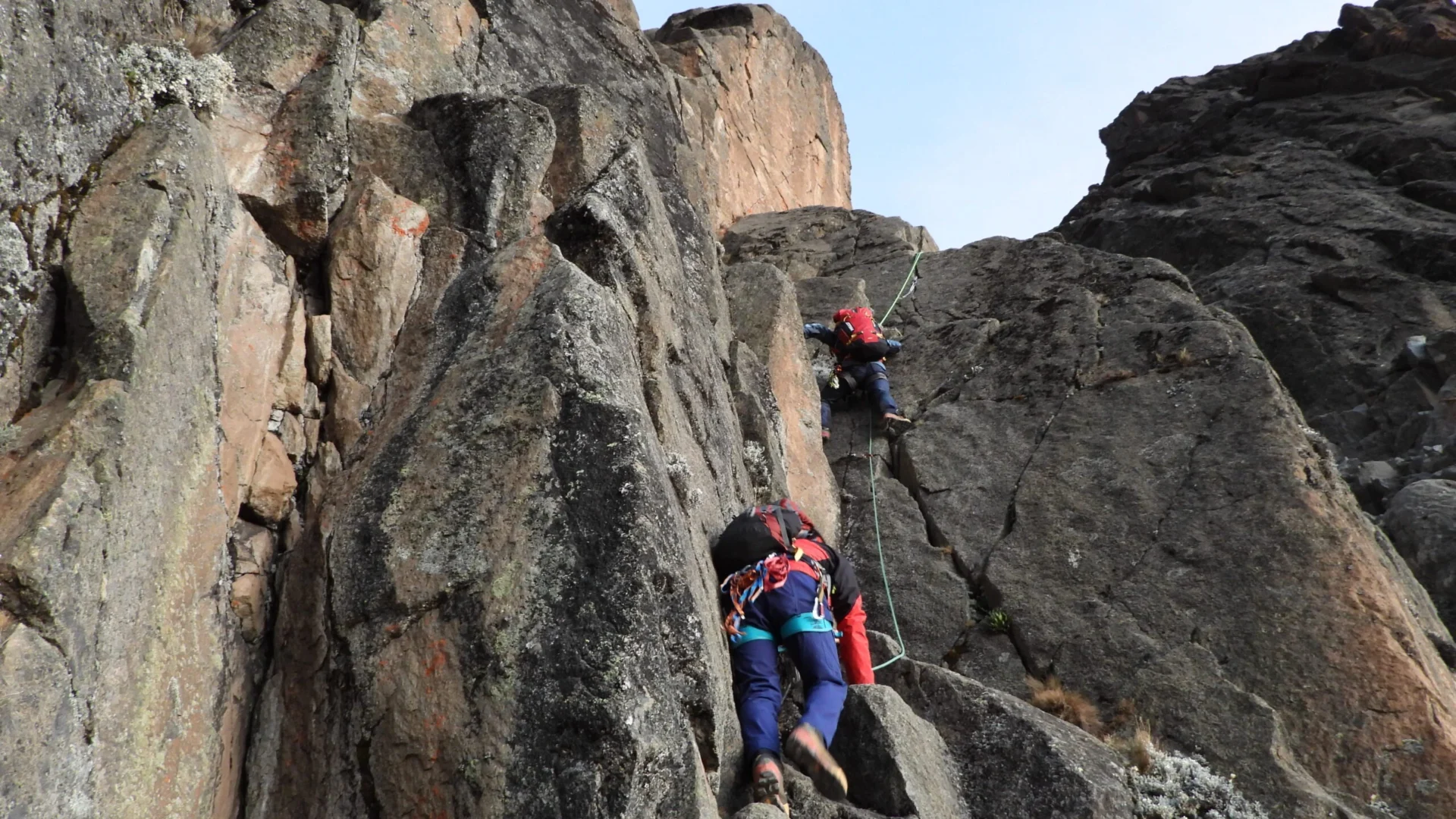
For the serious alpinist, UIAA Grade IV climbing in Kenya is more than just a number on a topo map—it is the definitive threshold between “trekking” and “true climbing.” While Grade III involves steep scrambling where a rope is often optional for the experienced, Grade IV on the rock faces of Mount Kenya or the towers of Hell’s Gate demands a technical lead, specialized protection, and a deep understanding of multi-pitch systems.
At Tour Africa, we view Grade IV as the “Gateway Grade.” It is where your movement must become efficient, your gear placements must be precise, and your mental fortitude is tested by sustained exposure.
Defining the Standard: What is UIAA Grade IV?
In the international UIAA (Union Internationale des Associations d’Alpinisme) system, Grade IV is classified as “Difficult.” In a controlled environment like a climbing gym, this translates to roughly YDS 5.6 to 5.7. However, in the Kenyan alpine context—specifically at 5,000 meters—a Grade IV pitch feels significantly more demanding due to hypoxia, heavy packs, and variable weather.
- The Technical Shift: At Grade IV, you are no longer just using your hands for balance. You are using specialized holds—side pulls, crimps, and jams—to move vertically.
- The Commitment: A Grade IV route in Kenya usually implies a full day of technical movement. It requires setting up multiple belay stations, managing rope drag on wandering pitches, and executing complex rappels during the descent.
Must Read: Best Route to Climb Mt Kenya
The Mount Kenya Benchmark: North Face Standard Route
When people search for “UIAA Grade IV climbing Kenya,” they are almost always looking at the North Face Standard Route to Batian (5,199m). This is the quintessential Grade IV alpine objective in Africa.
Pitch Dynamics on the North Face
The route offers roughly 18 to 22 pitches of climbing, the majority of which hover around Grade IV and IV+.
- The Amphitheatre: While parts of the amphitheatre are Grade III scrambling, the exit pitches transition into sustained Grade IV rock. Here, the rock is often firm phonolite, requiring precise nut and cam placements in narrow cracks.
- Firmin’s Tower: This is a classic example of a Grade IV+ crux. It involves a steep chimney and a vertical face that demands high-stepping and confident reach. On a cold morning with frost on the rock, this Grade IV feels world-class in its difficulty.
Training Ground: Hell’s Gate National Park
Before tackling the thin air of Mount Kenya, Tour Africa clients often head to Hell’s Gate in Naivasha for technical preparation. The gneiss walls here provide the perfect laboratory for Grade IV traditional climbing.
- Fisher’s Tower: Several routes on this iconic tower fall into the UIAA IV to V range. It is the ideal place to practice belaying a leader and cleaning a route.
- The Main Wall: For those looking for multi-pitch endurance, the Main Wall offers routes like “Fischer’s Cracks” which provide sustained Grade IV jamming and face climbing.
The Alpine Reality: Why Grade IV in Kenya is Unique
UIAA Grade IV Climbing Kenya requires a different strategy than climbing the same grade in the Alps or the Rockies.
1. The Equatorial Rule
Because Mount Kenya sits on the equator, the sun’s position changes the “climbability” of a Grade IV route. A route that is a “dry” Grade IV in August (North Face) might be an icy, inaccessible nightmare in January. Tour Africa synchronizes your climb with the solar cycle to ensure you are climbing warm, dry rock.
2. High-Altitude Multi-Pitching
At 17,000 feet, your heart rate at a Grade IV belay station is often higher than it would be during a sprint at sea level. Efficiency is safety. Every minute spent fumbling with a rappel device or a stuck cam is a minute lost to the inevitable afternoon storms.
3. The Logistics of the Lead
As of 2026, Kenya Wildlife Service (KWS) has tightened regulations on technical permits. To lead a Grade IV route, guides must demonstrate certified alpine proficiency. Our team at Tour Africa handles these eCitizen formalities, ensuring that your only focus is the next handhold.
Technical Skills Required for a Grade IV Ascent
To join a Tour Africa technical expedition, you should be comfortable with the following:
- Natural Protection: Placing nuts, hexes, and cams in various rock types.
- Anchor Building: Constructing multi-point anchors using slings and carabiners.
- The Rappel: Confident multi-stage abseiling on potentially loose rock.
- Acclimatization: Utilizing a plan like our Chogoria-Sirimon traverse to ensure your body can handle the physical strain of Grade IV movement at height.
Reach the True Summit with Tour Africa
Grade IV is where the “hikers” are filtered out and the “climbers” emerge. If you are ready to move beyond Point Lenana and touch the summits of Batian and Nelion, you need a team that understands the nuances of the Kenyan UIAA standard.
Must Read: Mount Kenya Technical Climbing Packages
FAQ on UIAA Grade IV Climbing Kenya
How does UIAA Grade IV on Mount Kenya compare to a climbing gym?
In a controlled indoor environment, Grade IV translates roughly to a YDS 5.6 or 5.7. However, on the North Face of Mount Kenya, the comparison ends there. At 5,000 meters, you are climbing in thin air with a pack, often in sub-zero temperatures. A Grade IV multi-pitch route at this altitude feels significantly more taxing than a Grade VI in a gym. You aren’t just fighting the rock; you’re fighting hypoxia and the daily equatorial weather cycle.
Do I need to be an expert to climb Grade IV routes in Kenya?
You don’t need to be a professional, but you must be a competent second or lead climber. For our technical packages, we require clients to be comfortable with multi-pitch transitions, basic belay techniques, and high-altitude endurance. If you can comfortably climb 5.9 at sea level, you have the technical overhead to handle Grade IV at altitude, provided you have a professional guide to manage the rack and route-finding.
What technical hardware is mandatory for these routes?
While Tour Africa provides the primary ropes and group rack, clients should be familiar with the gear being used. A standard 2026 technical ascent requires:
Dry-treated half-ropes (essential for the long rappel descents).
A full set of active protection (cams) and passive protection (nuts).
Personal alpine harnesses and rated climbing helmets.
Specialized rock shoes that are slightly oversized to allow for thin wool socks.
Why does the “Equatorial Rule” dictate Grade IV success?
On Mount Kenya, the sun is your best friend or your worst enemy. Because the mountain sits on the equator, the sun alternates between the northern and southern hemispheres.
July – September: The North Face (including the North Face Standard Route) is in the sun and dry.
December – March: The South East Face is the only viable option for a dry Grade IV climb. Attempting a Grade IV route on a “shadow” face usually involves climbing through ice and verglas, which pushes the difficulty far beyond the standard UIAA IV rating.
How are KWS permits and eCitizen logistics handled for technical climbs?
As of 2026, the Kenya Wildlife Service (KWS) requires specific technical climbing permits that are distinct from standard trekking passes. These must be secured via the eCitizen portal and require proof of a certified technical guide. Tour Africa manages this entire bureaucratic process for you. We also synchronize your permit with a mandatory Chogoria-Sirimon acclimatization schedule to ensure you don’t arrive at the base of a Grade IV pitch with altitude sickness.