
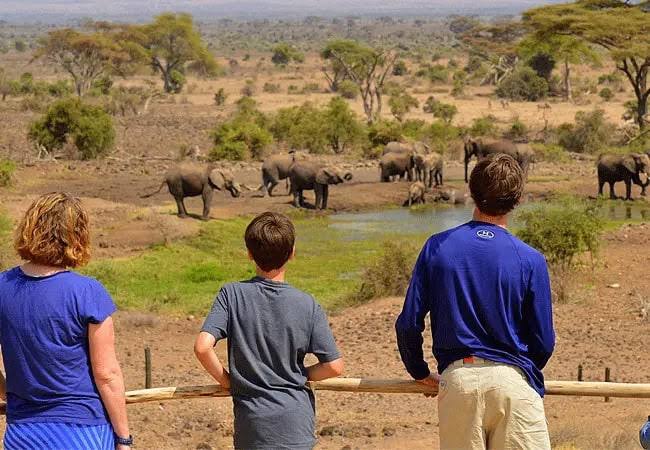
Kitirua Conservancy is a 25,000-acre private wildlife conservancy on the western edge of Amboseli National Park, running down to the Kenya–Tanzania border. Because it is private land rather than a national park, Kitirua permits the three things Amboseli does not: guided walking safaris, off-road driving, and night drives. Visitor numbers are capped, so you share the landscape with a handful of vehicles rather than a hundred.
If you have already decided that Amboseli’s elephants are the reason you’re coming to Kenya, Kitirua is how you see them without the convoy.
Where is Kitirua Conservancy?
Kitirua sits on Amboseli’s south-western boundary in Kajiado County, roughly 240 km from Nairobi and within sight of the Tanzanian border. It is Maasai group-ranch land, leased for conservation, and it forms part of the wider Amboseli ecosystem — an unfenced mosaic of park, conservancy and community land that elephants move across freely between Amboseli, the Chyulu Hills and Tsavo West.
Its immediate neighbours are the other Amboseli conservancies: Selenkay to the north, Kimana Sanctuary to the east on the Amboseli–Tsavo corridor, and Eselengei beyond. Each has a different character; we can talk you through which suits your dates — browse them all on our safari destinations page or get in touch directly.
Why stay in Kitirua Conservancy rather than Amboseli National Park?
This is the decision that shapes your whole trip, and most travellers make it without knowing the difference. Inside a Kenyan national park you must stay in your vehicle and on the roads, and the park is open to every day-tripper who pays the gate fee. A conservancy sets its own rules.
| Amboseli National Park | Kitirua Conservancy | |
|---|---|---|
| Walking safaris | Not permitted | Yes, with armed Maasai guides |
| Off-road driving | Not permitted | Yes |
| Night drives | Not permitted | Yes |
| Vehicles at a sighting | Often 10+ in peak season | Usually 1–2 |
| Day visitors | Unrestricted | Resident guests only |
| Elephant numbers | Exceptional — the swamps concentrate them | Very good, and calmer |
| Cost | Park entry fee | Conservancy fee per person per night |
The usual answer is to do both: sleep in Kitirua and drive into the park for the swamp elephants and the classic Kilimanjaro views. That is exactly how our Amboseli–Tsavo safari circuit is structured. For the full picture on where you can and cannot leave the vehicle in Kenya, see our guide to walking safaris in Kenya.
Wildlife in Kitirua Conservancy
Kitirua is open grassland and acacia woodland running into drier bush toward the border — a different habitat from Amboseli’s swamps, and it holds different animals as a result.
- Elephant. The Amboseli population is among the most studied on earth, and the big bulls move through Kitirua on their way between the swamps and the Chyulus. Seeing one on foot is the reason most people come.
- Predators. Lion, cheetah and spotted hyena are all resident. Cheetah do particularly well on the open ground here.
- Plains game. Giraffe, zebra, wildebeest, eland, Grant’s and Thomson’s gazelle, impala and warthog.
- Dry-country species. The border country supports gerenuk and fringe-eared oryx that you won’t reliably find in the park itself.
- Birds. More than 400 species have been recorded across the greater Amboseli ecosystem — worth a dedicated birding safari if that’s your thing.
Leopard are present but seldom seen. If ticking off the full set matters to you, read our complete guide to Kenya’s Big Five first — Amboseli is not a rhino destination, so a true Big Five trip needs a second location.
Things to do in Kitirua Conservancy
Walking safaris with Maasai guides
The headline activity, and the one you cannot do in the national park next door. Morning walks leave at first light with an armed professional guide and a Maasai tracker, covering five to eight kilometres at conversation pace — tracks, plants, bird calls, and frequently elephant at close quarters. Minimum age is usually 12. Everything we run on foot is listed on our Kenya walking safaris page, and the 3-day Maasai Cultural & Walking Safari is the dedicated version.
Off-road game drives and night drives
Being able to leave the track changes photography completely, and night drives open up a whole second cast — genet, civet, white-tailed mongoose, aardwolf if you are lucky, and lion actually hunting rather than sleeping.
Maasai culture
Kitirua is Maasai land and the guiding team are Maasai. Homestead visits here are arranged with the families who own the conservancy rather than staged for coaches. Our article on understanding Maasai culture is worth reading beforehand, and there are shorter cultural trips such as the Maji Moto 2-day trip and a day visit to a Maasai village from Nairobi.
Photography
Off-road access, low vehicle density and dust-free early light make Kitirua strong for photographers, particularly for elephant with Kilimanjaro behind. See our photographic safaris, our notes on safari wildlife photography, and the guide to private wildlife photography safaris in Kenya for vehicle and hide options.
Sundowners and fly-camping
Sundowners on a ridge facing the mountain are standard. Some operators will also set up a fly camp for a night under canvas away from the main camp — see how we run camping safaris.
Kilimanjaro views from Kitirua Conservancy
Kilimanjaro dominates the southern horizon, but it hides. The mountain builds cloud through the middle of the day and is usually clear only at dawn and in the last hour before sunset. Plan your best photographs around those two windows and don’t be discouraged by a blank sky at 11am — this is normal, and the mountain almost always shows itself at some point across a two-night stay. Clearest months are January to February and June to October.
Best time to visit Kitirua Conservancy
| Period | Conditions | Verdict |
|---|---|---|
| January–February | Hot, dry, short grass, clearest mountain views | Excellent |
| March | Building heat, first rains late | Good early in the month |
| April–May | Long rains, tall grass, dispersed wildlife | Poor for walking; lowest rates |
| June–October | Dry, cool mornings, wildlife concentrated on water | Excellent — peak season |
| November | Short rains, brief afternoon showers | Good, and quiet |
| December | Green, dust-free, festive rates | Very good |
Amboseli is dusty by the end of a long dry season — a real consideration for camera gear. For how this fits with the rest of the country, see our month-by-month Kenya safari calendar.
Getting to Kitirua Conservancy
By road: roughly five to six hours from Nairobi via Emali, the last stretch on rough murram. A high-clearance 4×4 is genuinely necessary, not a comfort preference — see Land Cruiser and tour van hire.
By air: scheduled light aircraft serve the Amboseli airstrips daily from Nairobi Wilson in about 45 minutes, with a short transfer to camp. If your itinerary is tight, this is the single best use of your budget — see fly-in safaris.
Self-driving: you can self-drive to Amboseli, but conservancy access and activities are generally restricted to guests of the camps and must be arranged in advance. Read self-drive safaris before committing to that plan.
Where Kitirua Conservancy fits in a Kenya itinerary
Two nights is the minimum that justifies the journey; three lets you walk, drive the park, and still have a slow morning. Common pairings:
- Amboseli + Tsavo — the classic southern circuit, on our Amboseli–Tsavo safari circuit
- Mara + Amboseli — the two headline ecosystems, as on the 7-day Grand Kenya safari
- Bush and beach — Amboseli then Diani or Watamu, as on our bush-to-beach family adventure
- With children — the 9-day family bush safari paces it properly for younger travellers
Browse everything on our Kenya safari tours, or tell us your dates and we’ll build it around you with a custom safari package.
What your conservancy fee actually pays for
Conservancy fees — charged per person per night on top of your accommodation — are a lease payment to the Maasai families who own this land. That payment is what makes keeping it unfenced and lightly grazed worth more than converting it to agriculture or settlement. It funds rangers, and in the Amboseli ecosystem it keeps open the corridors elephants need to move between the swamps, the Chyulus and Tsavo.
It is the most direct link between a safari booking and a conservation outcome that exists in Kenya, and it is why we push guests toward conservancies. See Kenya’s most endangered species and where to see them for what the model protects.
Plan your Kitirua safari
Tour Afric books the Amboseli conservancies with vetted local operators and certified walking guides. We’ll tell you honestly whether Kitirua, Selenkay or Kimana is the better fit for your dates, budget and how much you want to be on foot.
- Build a custom itinerary — dates in, draft back within one working day
- Start a booking or contact us on +254 717 563 531
- See the country first in our safari gallery
Related reading
- Walking safari Kenya: the complete guide — where you can legally walk, and where you can’t
- First-timer’s guide: what to expect on a Kenya safari
- Best time to visit Kenya: month-by-month calendar
- The ultimate Kenya travel guide 2026
- Beyond the Mara: 5 underrated Kenya destinations
- Best digital detox safari lodges in Kenya